What would happen if a vertebrate lost the protein responsible for carrying most of the oxygen in its blood?
In the freezing waters surrounding Antarctica, a family of fish has done something remarkably close to that.
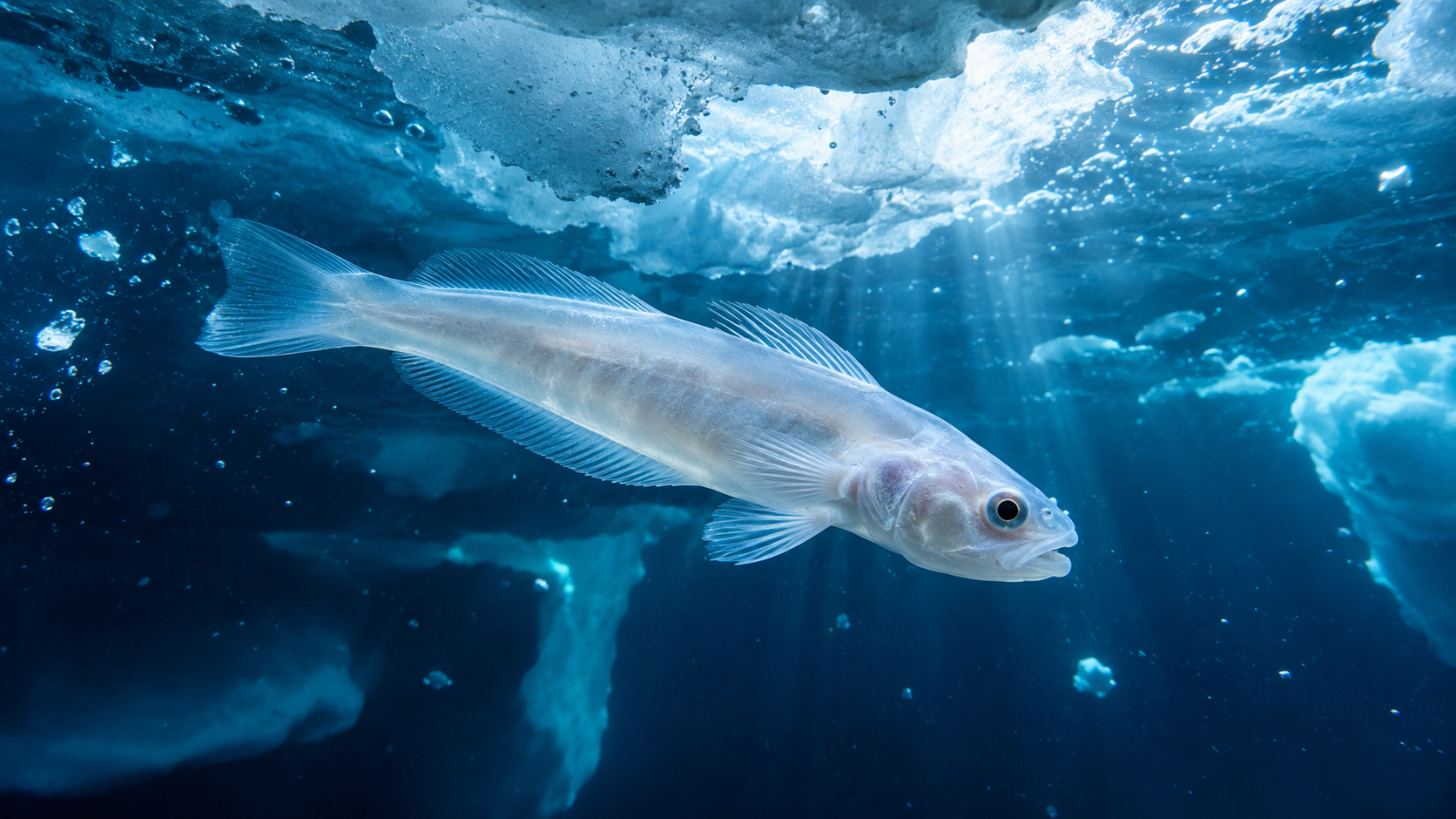
Antarctic icefish, members of the family Channichthyidae, are the only known vertebrates whose adults live without functional hemoglobin. They also lack the mature red blood cells that normally contain it, leaving their blood unusually pale and sometimes almost translucent.
That creates an extraordinary biological problem.
Without hemoglobin, how do these fish get enough oxygen to survive?
A Vertebrate That Lost Hemoglobin
For most vertebrates, oxygen transport depends heavily on red blood cells and hemoglobin.
Hemoglobin is a protein that binds oxygen and allows the circulatory system to move large amounts of it from respiratory organs to tissues. In humans, this system is so familiar that it is easy to forget how fundamental it seems.
Then Antarctic researchers found a fish that did not follow the pattern.
In 1954, Norwegian zoologist Johan T. Ruud described Antarctic fish lacking both red blood cells and blood pigment, helping establish one of the most unusual physiological discoveries in vertebrate biology.
Decades of research have confirmed that this is not simply a temporary condition. In adult icefish, oxygen is carried in the blood without the help of functional hemoglobin.
The difference is dramatic.
The oxygen-carrying capacity of icefish blood can be less than 10% of that of comparable red-blooded Antarctic fish.
So the fish did not eliminate the need for oxygen.
It eliminated one of the most efficient ways vertebrates normally transport it.
🔎 DID YOU KNOW?
Icefish blood can carry less than 10% as much oxygen as the blood of comparable red-blooded Antarctic fish. Without hemoglobin, the fish had to rely on a very different combination of environmental conditions and physiological adaptations to deliver enough oxygen to its tissues.
How Can It Survive Without Hemoglobin?
The answer begins with the environment.
Icefish live in the cold Southern Ocean, where low temperatures allow seawater to hold relatively large amounts of dissolved oxygen. The Antarctic environment is also highly mixed and generally well oxygenated.
But cold water alone cannot explain the survival of a fish with such a low oxygen-carrying capacity.
The fish still needs oxygen.
Its cells still need oxygen for aerobic metabolism.
Its muscles still need oxygen to work.
So where does the oxygen come from?
Instead of being carried primarily by hemoglobin inside red blood cells, oxygen remains physically dissolved in the blood plasma.
That is a far less efficient way to transport oxygen.
And yet the icefish has another trick.
Rather than carrying more oxygen per unit of blood, it moves much more blood through the body.
Icefish have unusually large hearts, high rates of blood flow, large blood volumes and relatively wide blood vessels compared with related red-blooded Antarctic fish. These characteristics help compensate for the low oxygen-carrying capacity of their blood.
The result is an extraordinary trade-off.
The blood is poor at carrying oxygen.
The circulatory system compensates by moving a great deal of it.
🚚 THE SIMPLE EXPLANATION
Imagine a city that normally delivers oxygen using thousands of highly efficient trucks.
Now imagine that those trucks suddenly disappear.
The city still needs supplies.
So instead of transporting more cargo in each truck, the city builds a much larger delivery network and moves far more traffic through it.
That is roughly what the icefish has evolved to do. It did not stop needing oxygen. It changed the way oxygen moves through its body.
The Cost of Living Without Hemoglobin
It would be tempting to describe the loss of hemoglobin as an evolutionary upgrade.
The evidence suggests something more complicated.
The absence of hemoglobin creates real physiological costs.
Because icefish blood carries much less oxygen, their circulatory systems must work harder to maintain oxygen delivery. Their cardiovascular systems therefore show extensive modifications that are unusual among vertebrates.
This is why scientists do not simply describe the loss of hemoglobin as a beneficial invention.
Instead, the icefish story is a story of loss followed by compensation.
One system disappeared.
Other systems changed around it.
This distinction matters because evolution does not work like an engineer designing an organism from scratch. A trait can disappear, persist under particular environmental conditions, and be accompanied by other changes that reduce its disadvantages.
In icefish, the result is a remarkably complex physiological compromise.
Their Hearts Are Built Differently
Perhaps the most striking part of the story is the heart.
Compared with similarly sized red-blooded Antarctic fish, icefish generally have much larger hearts and can maintain exceptionally high blood flow. Their blood vessels are also unusually large in diameter.
Their adaptations do not stop there.
Researchers have identified changes involving blood volume, vascular structure, tissue oxygen supply and cellular energy systems. Some species also lack myoglobin, an oxygen-binding protein found in muscle, adding another extraordinary example of oxygen-related protein loss within the icefish family.
The important point is that there is no single "replacement" for hemoglobin.
The compensation is distributed across the entire organism.
The heart changes.
The vessels change.
The blood changes.
The tissues change.
Even the way cells manage oxygen can change.
The fish is not using one clever substitute.
It is using an entire physiological system built around the absence of hemoglobin.
How Did This Strange Trait Evolve?
The next mystery is even deeper.
How does a vertebrate lineage lose something as fundamental as hemoglobin in the first place?
Genomic research has shown that the ancestors of modern icefish once possessed the genetic machinery associated with hemoglobin.
Over evolutionary time, the icefish lineage lost functional hemoglobin genes.
Earlier studies found remnants of hemoglobin-related sequences, helping researchers reconstruct this unusual evolutionary history.
And research published in 2025 provided a more detailed picture of how the loss may have happened.
Scientists compared the genomic regions containing hemoglobin gene clusters in red-blooded Antarctic relatives with their corresponding regions in icefish. They found evidence that the two major hemoglobin clusters were lost independently through different genomic mechanisms, with transposable and repeat-like elements implicated in the deletions.
That helps answer an important question: How were the genes lost?
But another question remains harder: Why did the loss persist?
A Changing Antarctic Environment
One important clue comes from the environment itself.
The Southern Ocean became progressively colder over millions of years, increasing the amount of oxygen that could remain dissolved in the water.
Research combining paleoclimate records with comparative genomics found that the loss of mature red blood cells in icefish occurred after prolonged cooling of the Southern Ocean. The study suggests that environmental change created conditions under which extreme modifications to the erythrocyte system became possible.
Another line of research has proposed that limited iron availability may also have contributed to the evolution of reduced or absent hemoglobin.
That idea is intriguing, but it remains a hypothesis, rather than a settled explanation for why hemoglobin disappeared.
The safest scientific conclusion is therefore not "Scientists know exactly why the fish lost hemoglobin."
It is: Scientists are gradually reconstructing how the loss happened and which environmental conditions may have allowed it to persist.
That uncertainty is part of the story.
🔎 DID YOU KNOW?
The loss of hemoglobin was not necessarily a single simple genetic event. A 2025 genomic study found evidence that the two major hemoglobin gene clusters were deleted through different mechanisms during the evolution of the icefish lineage.
But Why Doesn't Their Blood Look Red?
Human blood looks red because of the large concentration of hemoglobin inside red blood cells.
Remove that pigment, and the familiar color disappears.
This is why icefish are sometimes called "white-blooded" fish.
But the name can be misleading.
Their blood is not literally a thick, opaque white liquid.
Without the high concentration of hemoglobin normally found in red blood cells, icefish blood can appear very pale or translucent.
It is one of those rare cases where biology makes the familiar seem strange.
Blood does not have to be red.
It is red because of the chemistry that usually carries oxygen.
A Natural Experiment in Evolution
Antarctic icefish give scientists an extraordinary opportunity to study what happens when a system that appears fundamental to vertebrate life disappears.
They allow researchers to investigate questions about oxygen transport, cardiovascular physiology, blood composition, mitochondria, evolution and adaptation to extreme environments.
The icefish also offers a broader lesson.
Evolution does not always produce a perfect replacement for a lost trait.
Sometimes it produces something messier. Something more expensive. Something that only works because the environment makes it possible.
And that may be what makes the icefish so fascinating.
It is not a fish that escaped the rules of biology.
It is a fish that shows us how many different ways life can work within them.
How we researched this article:
CurOLO reviewed peer-reviewed scientific literature on Antarctic icefish physiology, oxygen transport, erythrocyte loss, cardiovascular adaptation and the evolution of hemoglobin loss. Scientific findings are explained in simpler language for readers without a specialized background. Where researchers disagree or where an explanation remains hypothetical, the article distinguishes established findings from proposed explanations.
Scientific References & Sources
- Sidell, B. D., & O'Brien, K. M. (2006). When bad things happen to good fish: the loss of hemoglobin and myoglobin expression in Antarctic icefishes. Journal of Experimental Biology, 209(10), 1791–1802. DOI
- Ruud, J. T. (1954). Vertebrates without erythrocytes and blood pigment. Nature, 173, 848–850. DOI
- Desvignes, T., Rivera-Colón, A. G., & Postlethwait, J. H. (2025). Hemoglobin-Gene Cluster Deletions in Antarctic White-Blooded Icefishes Facilitated by Transposable Elements. Genome Biology and Evolution, 17(10). DOI
- Albertson et al. (2020). Developmental constraint shaped genome evolution and erythrocyte loss in Antarctic fishes following paleoclimate change. PLoS Genetics.
- Corliss et al. (2019). Vascular Expression of Hemoglobin Alpha in Antarctic Icefish Supports Iron Limitation as Novel Evolutionary Driver. Frontiers in Physiology.